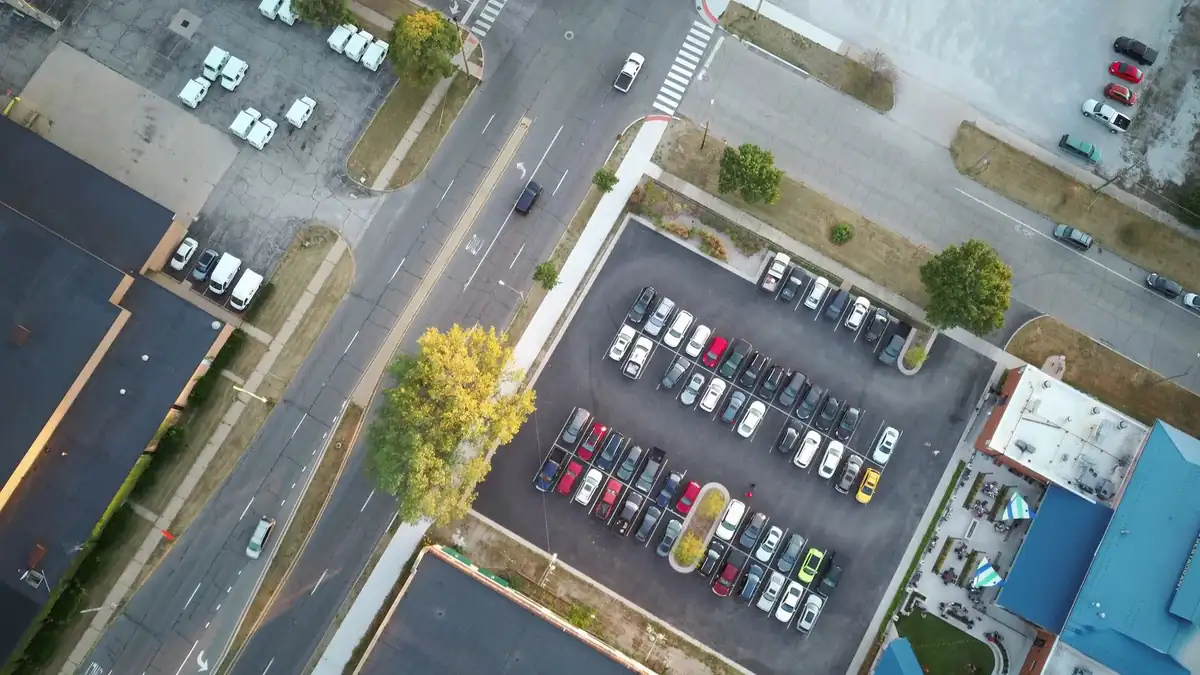
A well-designed parking lot does two things at once: it fits the most cars and it moves them safely. Get the geometry right and drivers flow in, park, and leave without confusion. Get it wrong and you've got fender-benders, wasted asphalt, and a lot that feels chaotic even when it's half empty.
Whether you're paving a new lot or reconfiguring an old one during resurfacing, here's how the pros think about layout.
Angle vs. 90-Degree Parking
The first big decision is the parking angle, and it's a genuine trade-off:
- 90-degree (perpendicular): fits the most cars per row and works for two-way traffic. It demands wider drive aisles because cars back straight out. Best for high-volume lots with room to spare.
- 60-degree angle: easier to pull into, needs narrower aisles, and moves traffic one-way. You lose a little capacity but gain smoother flow and fewer scrapes.
- 45-degree angle: the easiest to enter and the most forgiving for tight sites, but the lowest capacity per square foot.
As a rule: choose 90-degree when you want maximum count and have space, and choose angled parking when your lot is tight, oddly shaped, or you want to guide traffic in one direction.
Drive Aisle Widths
Aisles are where efficiency and safety meet. Too narrow and drivers can't maneuver; too wide and you've paved space that could've been stalls. General targets:
- Two-way drive aisle with 90-degree parking: around 24 feet
- One-way aisle with 60-degree parking: around 18 feet
- One-way aisle with 45-degree parking: often 12 to 15 feet
Standard stall dimensions run about 9 feet wide by 18 feet deep, though premium retail sometimes goes to 9.5 feet for customer comfort and industrial lots size up for trucks. Confirm minimums with your local code — municipalities publish their own required dimensions.
The most common layout mistake isn't the stalls — it's the aisles. Skimp on aisle width and you'll spend the next decade cleaning up mirror strikes and bumper scrapes.
Traffic Flow and Circulation
A great layout reads itself. Drivers should know where to go without thinking. Build in:
- A clear, unobstructed entrance and a separate exit where the site allows
- Continuous circulation so no one hits a dead end and has to reverse
- Perpendicular access to the main entrance for accessible spaces, kept closest to the door
- Painted directional arrows and stop bars to reinforce one-way sections
- Pedestrian crosswalks striped between parking areas and the building entrance
Don't Forget Compliance and Drainage
Two things quietly make or break a layout. First, ADA accessible spaces — they must be closest to the entrance, correctly sized, and connected by an accessible route. Bake them in from the start; retrofitting them later usually means tearing up prime spots. Our ADA striping guide covers the specifics.
Second, drainage. In Florida, a lot that doesn't shed water fast fails early — standing water destroys both asphalt and striping. Good grading and slope are part of layout, not an afterthought, which is why we plan them together during asphalt paving.
Common Layout Mistakes to Avoid
We're often called in to fix lots that were laid out poorly the first time. The same handful of mistakes come up again and again:
- Aisles too narrow for the parking angle — the top cause of chronic mirror strikes and bumper scrapes
- Dead-end aisles that force drivers to reverse the length of a row to escape
- Accessible spaces placed far from the entrance or connected by a route that crosses traffic
- Ignoring truck and delivery access — box trucks and garbage trucks need turning room a car-sized layout doesn't provide
- Cramming in extra stalls at the expense of circulation, so a "high-capacity" lot actually functions worse
The theme is always the same: chasing raw stall count at the expense of how the lot actually flows. A slightly smaller count that circulates cleanly beats a crowded lot that fights its own drivers every day.
The Bottom Line
Efficient layout is a balance: maximize count without crowding aisles, guide traffic without confusing it, and never sacrifice compliance or drainage for a few extra stalls. If you're planning a new lot or rethinking an existing one, we'll help you map the most spaces your site can safely hold. Get a free estimate.
Need a Free Estimate?
Iron Ridge Pavement gives upfront, no-obligation pricing on paving, sealcoating, striping and repairs across Florida.