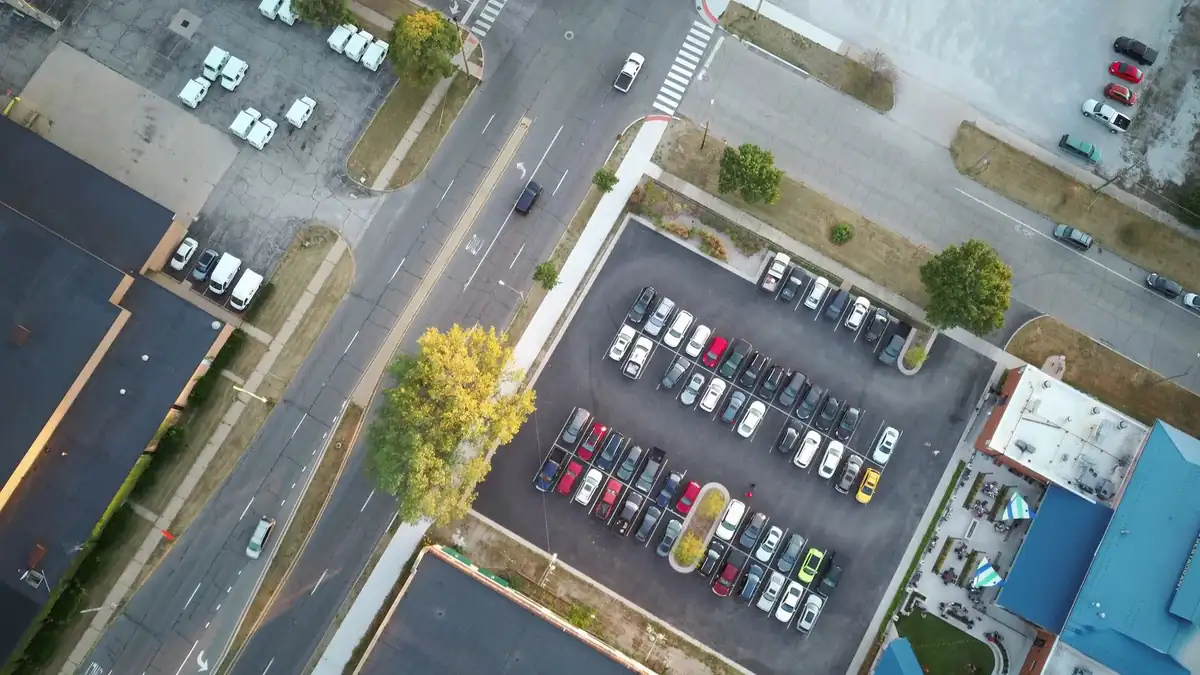
The stretch of Seminole County between Lake Mary and Sanford holds a dense concentration of commercial pavement: office parks along Lake Mary Boulevard and International Parkway, medical and professional plazas, retail centres near the I-4 interchanges, and industrial and logistics properties toward the airport. Much of it was built during the same growth waves, and it is now reaching the stage where maintenance decisions carry real money.
Office parks: lots that age quietly
Office park lots see steady, moderate traffic: staff arriving in the morning, leaving in the evening, and relatively little turning or heavy-vehicle use except at delivery entrances. That means they age slowly and evenly, and their main enemy is the sun. Oxidation fades and embrittles the surface, fine cracking opens up, and if the sealcoat cycle lapses, water gets in and the decline accelerates. These are the lots where a disciplined sealcoating and crack-filling schedule pays off most, because there is often little else wrong. Our post on how often to sealcoat in Florida covers the interval.
Medical and professional plazas
Medical plazas have a specific set of needs. Accessible parking has to be correct and plentiful, patient drop-off zones take constant turning and idling traffic, and the lot cannot be closed for long because appointments do not stop. Work here is phased tightly, often in sections over several days, with accessible routes to every entrance maintained throughout. Our post on minimising business disruption during paving explains how that phasing works.
Retail near the interchanges
- High turnover traffic with constant turning at entrances and drive-through lanes, which is where rutting and slippage show up first.
- Delivery trucks using the same lot as customers, often through areas built to car specification.
- Peak-hour and weekend traffic that limits when work can be done, pushing most of it into early mornings and overnight windows.
- Tenants with their own hours and expectations, all of whom need to be told what is happening and when.
Along the I-4 corridor the pavement was mostly built at the same time. The maintenance calendar should recognise that.
Industrial toward the airport
Properties near Orlando Sanford International Airport and the industrial corridors carry truck traffic that needs a heavier pavement section than the office and retail lots to the south. The failures there are at turning areas and dock aprons, and the fix is to build those zones differently. Our post on heavy-duty asphalt for truck yards and loading docks goes into the detail.
Drainage and the lakes
The corridor is threaded with lakes and wetlands, and many commercial sites drain to retention ponds that have to be kept working. A lot whose drainage structures are blocked or whose grade has settled sends water into the base, which is where the expensive failures begin. Any condition assessment here should look at the inlets and the flow paths, not just the surface. Our post on drainage and grading in Florida explains why.
Planning across a portfolio
Owners and managers with several properties along the corridor benefit from treating them as one program: assess all of them, rank them by condition, and sequence the sealcoating, repairs and overlays across years rather than reacting property by property. Our commercial parking lot services are set up to work that way.
Tenants deserve a mention too. Multi-tenant properties along the corridor have restaurants, clinics, gyms and offices that open at different hours, and the schedule for sealcoating or repairs has to be shared with all of them in advance. A property manager who circulates the plan a week ahead has a far easier day than one who does not.
Need a Free Estimate?
Iron Ridge Pavement gives upfront, no-obligation pricing on paving, sealcoating, striping and repairs across Florida.
Iron Ridge Pavement LLC maintains and rebuilds commercial lots throughout Lake Mary, Sanford, Longwood and the I-4 corridor. Request a portfolio assessment.